


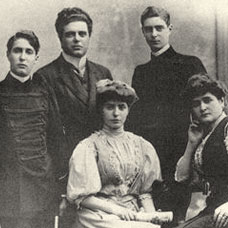
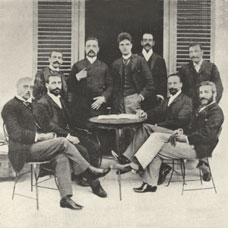
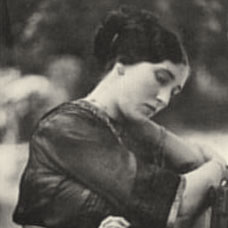
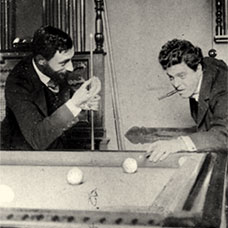
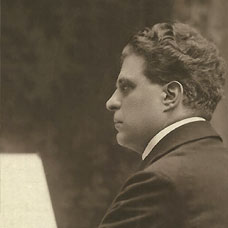
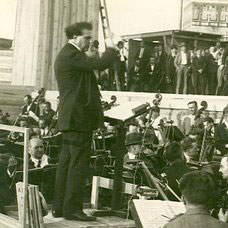
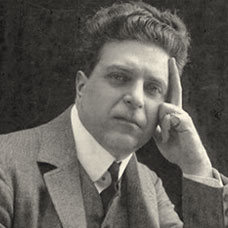
According to Mario Morini a demanding Mascagnian biographer, the Mascagni family came from an ancient Florentine branch.
They first settled in San Miniato al Tedesco in the 18th century. They belonged to the upper middle class. Paolo Mascagni (1755-1815) was a famous anatomist and professor at the universities of Pisa and Florence. Around 1850 Antonio Mascagni settled in Leghorn. 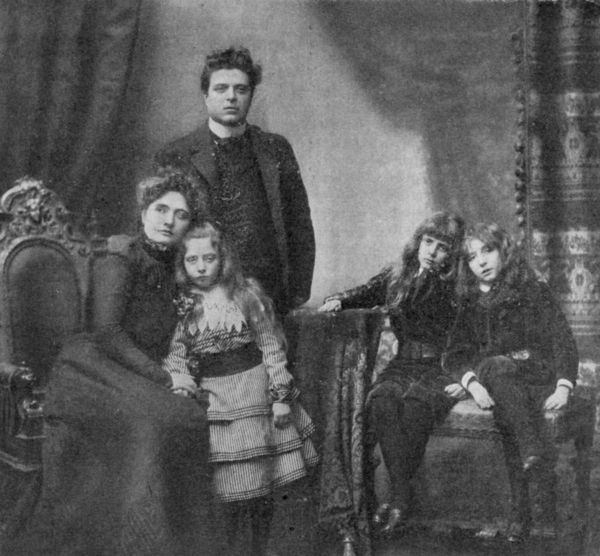 His son, Domenico, born in 1834, married a Leghorn native, Emilia Reboa di Stefano.Domenico was the owner of a bakery in Piazza delle Erbe which was the place of a brightly coloured picturesque fruit and vegetable market.
On 7 December 1863 Pietro Mascagni was born at dawn. Pietro Antonio Stefano was the second child of Domenico and Emilia who had in all five children: Francesco, Pietro, Carlo, Maria and Paolo. In 1873 Emilia died at the age of only 32 and for her husband Domenico it was a tragedy. He had to take care of his family alone. Domenico wanted to pass the bakery down to his oldest son Francesco while Pietro, who was called Pietrino, showed a precocious and lively intelligence. Domenico hoped that Pietrino who choose a career in law. but Pietro’s dreamed of becoming a musical composer.The young Mascagni began his career with the moral and financial help of his uncle Stefano. Uncle Stefano also helped Pietro through his high school years and during the time Mascagni went to study music in spite of his father’s dreams of a law career for his son. Other than studying the piano, the young Mascagni began a singing as a contralto in the Scola Cantorum in the church of San Benedetto.
Mascagni himself tells us that at thirteen he found a libretto entitled Zilia. Zilia is about one of the voyages of Christopher Columbus. Mascagni possessed only rudimentary keyboard for the piano spent hours looking for melodies to adapt to the verses. All the noise that resulted from Mascagni’s piano playing exasperated his father who ended up burning the precious libretto. Pietro succeeded in saving and hiding away the musical notes. He would later partially use these notes, according to a direct witness, in Guglielmo Ratcliff.
1882 In May, he left for Milan (Epistolario Vol. May 2 letter to Soffredini) thanks to the economic aid of Count Florestano de Larderel. In October he passed the entrance test at the Conservatory. He meets the Milanese artistic environment and becomes a friend of Giacomo Puccini and Vittorio Gianfranceschi, engineer, passionate music connoisseur, destined to become his fraternal friend for the rest of his life.
1883 His sister dies. He resumes the singing In filanda and turns him for a competition in a work in two acts.
1884 His relationship with the Conservatory is getting tense. He composed the romance for tenor with orchestra The King in Naples, in the words of Andrea Maffei. Maffei himself is the translator of Heinz William Ratcliff whom Mascagni begins to devote himself to, dreaming of the great work.
1885 After a controversial conversation with the director of the Conservatory he withdrew from the Institute and abandoned his regular studies. To maintain himself he starts a long peregrination around Italy with operetta companies as an orchestra conductor (see Epistolary vol. The letter of 1885-25 April sent to Gianfranceschi).
1886 The actor and operetta director Luigi Maresca engages him as conductor and with him, after a long tour, arrives at Cerignola, in Puglia. In the meantime he was linked to Argenide Marcellina (Lina) Carbognani (1862-1946) known in Parma.
1888 On February 7 Peter and Lina marry in the Cathedral of Cerignola. On February 7, the composer conducts his Glorious Mass interpreted by the pupils of his school. In July on the "Illustrated Theater" appears the announcement of the contest by the editor Sonzogno for an act in an act. Mascagni decides to participate, chooses Cavalleria Rusticana of Verga and , as the librettist his friend Livornese Giovanni Targioni-Tozzetti (1863-1934), to which will be added Guido Menasci (1867-1925) (Epistolario vol.For the letter of December 14, 1888 to Targioni -Tozzetti).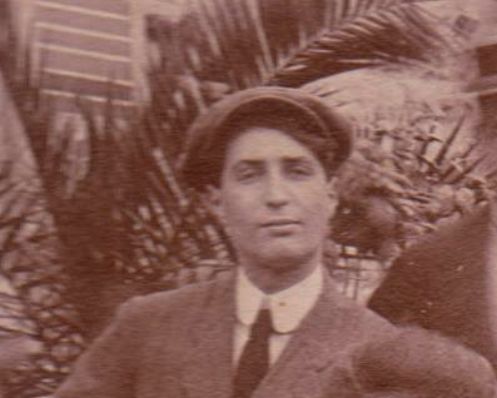
1889 On February 3rd, his son Domenico was born, nicknamed Mimì, in May he concludes the work of Cavalleria Rusticana.
1890 The Jury of the Sonzogno Competition proclaims the three winning works on 73 participants: Cavalleria Rusticana precedes in the list of Labilia by Nicola Spinelli and Rudello by Vincenzo Ferroni. (Epistemic Vol. The letter of 10 March 1890 to Targioni-Tozzetti and Menasci). On May 17, Cavalleria Rusticana debuted at the Teatro Costanzi in Rome, obtaining a resounding public success in many Italian and foreign theaters.
1891 On January 3rd, the second son of Pietro and Lina, Edoardo (Dino), was born in Cerignola. Godfather is Edoardo Sonzogno. The realization of L'Amico Fritz is here. The work is represented at Costanzi in Rome on October 31st.
1892 The daughter of Emilia (Emy) was born in Livorno on 21 August. In September he participates in the Vienna Musical Exposition with Cavalleria Rusticana and L'Amico Fritz. On November 10, the Rantzau scenes on the pergola of Florence.
1893 The Verga-Mascagni-Sonzogno legal dispute over the Cavalleria Rusticana copyright ends.
1895 The 16th of February the opera William Ratcliff is represented: a tragedy in four acts by Heine, on the podium as conductor, Mascagni himself. On March 25th always at Teatro alla Scala Silvano, a navy drama in two acts by Targioni-Tozzetti. In October he was appointed director at Rossini Liceo in Pesaro.
1896 In February at the high school he directed the Petite Mass of Rossini and on March 2 he staged Zanetto, an act of Targioni-Tozzetti by Passant of Coppée. Replicated March 18 at Scala.
1897 Started with Luigi Illica (1857-1919) with Iris, commissioned by Ricordi.
1898 In March and April, he directed six major concerts at Scala, performing for the first time in Italy, Cajkovski's Patetica. On 29 June in Recanati, at the celebrations for the centenary of Leopardi's birth, Mascagni directed his symphonic poem A Giacomo Leopardi for orchestra and soprano voice. On 22 November at Costanzi Theatre he conducts Iris, three acts on Illica's libretto.
 1899 In maggio iniziano a Pesaro i concerti con l'Orchestra del Liceo diretta da Mascagni. A maggio muore il padre Domenico.
1909 In August he assumes the artistic direction of the Teatro Costanzi in Rome. He starts working at Isabeau together with Illica.
1910 Leave the direction of Teatro Costanzi. Concludes Isabeau. In April, she is sentimentally linked to Anna Lolli, a young Romagna chorus.
1911 On April 10, before sailing for South America, gives a preview of Isabeau without scenes and costumes at Carlo Felice in Genoa. On June 2, Isabeau, acting in three acts by Illica, debuts at the Teatro Coliseo in Buenos Aires. The South American tour lasts 7 months.
1912 On 20 January Mascagni at the Fenice and Tullio Serafin at Scala direct Isabeau at the same time. In April from Arcachon, D'Annunzio sends to Mascagni the manuscript of Parisina. In May Mascagni, under a false name, reaches D'Annunzio in France at Bellevue, in the company of his daughter Emy and Anna Lolli. There he writes together with the poet, Parisine.
1913 On Dec. 15 at Scala the Premiere of Parisina. Directed by the author. The excessive length of the work is blamed, and Mascagni in replicas suppresses the entire fourth act.
1915 He starts to write by an invitation of Cines, the soundtrack for the Satanic Rapsodia, movie by Lyda Borelli and directed by Nino Oxilia.
1917 In April he staged at the Teatro Costanzi di Roma Lodoletta, on a booklet by Giovacchino Forzano.
1919 Al Quirino goes on the operetta Yes, in three acts by Carlo Lombardo.
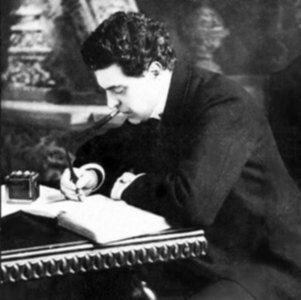 1921 On May 2 at Costanzi he directed the new work, Il Piccolo Marat, three acts of Forzano Youth.
1922 In May Mascagni departs for a new six-month tour in South America.
1923 On January 14, at the Augustus of Rome, he directed the Lyrical Vision (Looking at St. Therese of Bernini).
1924 In November he goes to Vienna, and is informed with pain about the death of his friend Puccini.
1925 The tour continues in Prague, Warsaw and Budapest.
1927 Mascagni is delegated by the Government to represent Italy at the celebrations held in Vienna for the centenary of Beethoven's death.
1929 On October 18, the Royal Academy of Italy was inaugurated. Among the distinguished personalities of the title range, next to Guglielmo Marconi, Luigi Pirandello, Enrico Fermi, Gabriele D'Annunzio there is Pietro Mascagni.
1932 On March 23 at the San Remo Casino Theater, the young Pinotta resumes idyll in two acts.
1935 On January 16 at Scala , it sees the light Nero, the last Mascagni fatigue, three acts by Targioni-Tozzetti from the play by Pietro Cossa
1940 For the fiftieth anniversary of Cavalleria Rusticana, he contributed to the work on record.
1943-44 For the fiftieth anniversary of Cavalleria Rusticana, he contributed to the work on record.
1945 On August 2, in the bedroom of his apartment at the Grand Hotel Plaza in Rome (his residence since 1927) Mascagni dies.
His Family - His Friends - His Women - His Passions - His Tours - On the podium - Portrait of an artist